
Best Features to Look for in a Stationary Concrete Batching Plant
A stationary concrete batching plant is a major investment for ready-mix concrete producers, precast manufacturers, infrastructure contractors, and large construction companies. Unlike mobile batching plants, stationary plants are designed for long-term operation at a fixed location and are usually selected for projects requiring stable, high-volume concrete production.
However, not every batching plant offers the same productivity, accuracy, reliability, or operating cost.
For buyers, the right question is not simply:
“What capacity batching plant should I buy?”
A better question is:
“Which features will help the plant maintain stable production, consistent concrete quality, and lower operating costs over its service life?”
This guide explains the most important features to evaluate when choosing a stationary concrete batching plant.
What Is a Stationary Concrete Batching Plant?
A stationary concrete batching plant is a fixed concrete production system used to accurately measure, mix, and discharge concrete ingredients.
A typical plant includes:
Aggregate batching system
Aggregate conveying system
Cement silos
Screw conveyors
Cement weighing system
Water weighing system
Admixture dosing system
Concrete mixer
Control system
Pneumatic system
Dust collection equipment
Discharge system
Compared with mobile plants, stationary batching plants generally provide:
Higher production capacity
Larger aggregate storage
Better suitability for continuous operation
More customization options
Greater automation potential
Better integration with large concrete production facilities
They are commonly used in ready-mix concrete plants, precast factories, highway projects, airports, dams, large industrial facilities, and major infrastructure projects.
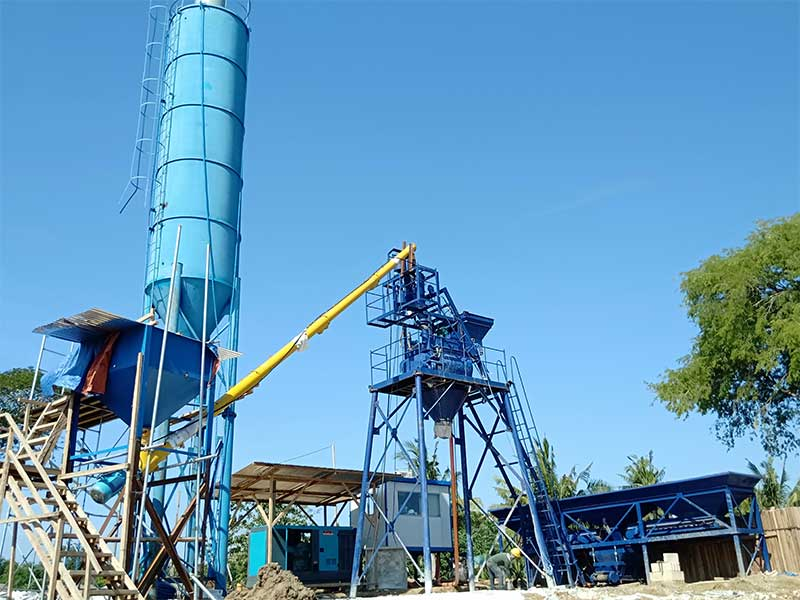
1. Reliable Concrete Mixer
The mixer is one of the most important components of any stationary concrete batching plant.
Its performance directly affects:
Concrete uniformity
Mixing time
Production capacity
Energy consumption
Maintenance requirements
Final concrete quality
For high-output commercial concrete production, twin-shaft concrete mixers are commonly used.
Why twin-shaft mixers are popular
Twin-shaft mixers provide intensive mixing through two horizontally mounted shafts equipped with mixing arms and blades.
They are suitable for producing:
Ready-mix concrete
High-strength concrete
Dry concrete
Plastic concrete
Precast concrete
Fiber-reinforced concrete
Their relatively short mixing cycle can also support high plant productivity.
When evaluating a mixer, buyers should consider:
Mixer model
Rated output per batch
Motor power
Mixing cycle
Blade material
Liner wear resistance
Shaft seal design
Lubrication system
Maintenance access
A high-capacity batching plant with a poor-quality mixer will rarely achieve reliable long-term production.
2. Accurate Aggregate Batching System
Aggregates usually represent the largest portion of a concrete mix.
Therefore, accurate aggregate measurement is critical.
Typical materials include:
Sand
Crushed stone
Gravel
Manufactured sand
Different aggregate sizes
The aggregate batching system should be capable of controlling each material according to the selected mix design.
What buyers should evaluate
Look at:
Number of aggregate bins
Bin volume
Weighing accuracy
Feeding method
Discharge gate design
Vibrator configuration
Load cell quality
Aggregate feeding speed
Plants may include three, four, five, or more aggregate compartments depending on production requirements.
Projects requiring several different aggregate grades may need additional bins.
3. High Weighing Accuracy
Batching accuracy has a direct impact on concrete consistency.
A good stationary concrete batching plant should use independent weighing systems for major materials.
These may include:
Aggregate weighing
Cement weighing
Fly ash weighing
Water weighing
Admixture weighing
Reliable load cells and control algorithms help maintain stable batch proportions.
Why weighing accuracy matters
Poor weighing accuracy can result in:
Inconsistent compressive strength
Excessive cement consumption
Slump variation
Poor workability
Mix design deviations
Quality-control problems
For ready-mix producers serving structural projects, stable weighing performance is particularly important because concrete must consistently meet specified grades.
4. Efficient Aggregate Conveying System
After batching, aggregates must be transported to the mixer.
Two common systems are:
Belt conveyor
Belt conveyors are often used in medium- and large-capacity plants.
Advantages may include:
High conveying capacity
Continuous feeding
Efficient high-volume operation
Lower aggregate impact
Skip hopper
Skip systems are generally more compact.
They may be suitable when:
Plant footprint is limited
Production capacity is moderate
Site layout favors vertical lifting
For high-output commercial plants, belt conveyor systems are frequently preferred.
Buyers should evaluate both production requirements and available land before selecting the conveying design.
5. Large Aggregate Storage Capacity
Aggregate storage capacity affects how smoothly the plant can operate.
If storage bins are too small, loaders must constantly refill them.
This can increase:
Loader operating hours
Fuel consumption
Labor requirements
Production interruptions
Large-volume bins are especially useful for busy ready-mix concrete plants.
Important factors include:
Total storage capacity
Number of compartments
Aggregate consumption per hour
Loader refill frequency
Material supply schedule
The correct bin size should be based on actual daily production rather than only the rated batching plant capacity.
6. Properly Sized Cement Silos
Cement storage is another major consideration.
A stationary batching plant may use one or multiple cement silos depending on production requirements.
Common materials stored in silos include:
Portland cement
Fly ash
Slag powder
Supplementary cementitious materials
Using multiple silos allows producers to manufacture different concrete formulations.
Important silo features
Buyers should check for:
Capacity
Level indicators
Dust collectors
Pressure relief valves
Aeration systems
Discharge valves
Strong structural design
The silo capacity should match both production volume and cement delivery frequency.
7. Intelligent PLC Control System
Modern stationary batching plants should provide a reliable automated control system.
PLC-based systems can automate the complete batching and mixing cycle.
Functions may include:
Formula management
Automatic material weighing
Batch sequencing
Mixer control
Production monitoring
Alarm recording
Batch history
Manual operating mode
Production reports
Automation helps reduce operator dependence and improves consistency.
Recipe management
This is especially important for ready-mix producers manufacturing many concrete grades.
Operators should be able to store and retrieve different recipes quickly.
For example:
C20 concrete
C25 concrete
C30 concrete
C40 concrete
High-strength concrete
Special-purpose concrete
The system then automatically controls material proportions based on the selected formula.
8. Real-Time Production Monitoring
A strong control system should provide more than automatic batching.
Operators should also be able to monitor production data in real time.
Useful information may include:
Aggregate weight
Cement weight
Water dosage
Admixture dosage
Mixing status
Batch number
Current recipe
Production output
Alarm conditions
This gives operators better visibility into plant performance.
For plant managers, production records can also assist with:
Quality control
Cost analysis
Material inventory
Customer documentation
Production planning
9. Fast Mixing Cycle
Production capacity is determined not only by mixer size but also by total batch cycle time.
A batching cycle includes:
Material weighing
Aggregate feeding
Cement feeding
Water and admixture dosing
Mixing
Concrete discharge
Reducing unnecessary delays between these stages can significantly increase actual hourly production.
Therefore, buyers should compare realistic production capacity, not just theoretical capacity.
For example, a plant advertised as 120 m³/h may produce less under certain operating conditions depending on:
Concrete recipe
Material feeding speed
Mixer cycle
Aggregate moisture
Discharge time
Operator settings
10. Automatic Moisture Compensation
Aggregate moisture can significantly affect concrete water content.
Sand moisture, in particular, may change throughout the day because of:
Rain
Humidity
Storage conditions
Temperature
Without moisture adjustment, additional water contained in wet aggregates may change the effective water-cement ratio.
Moisture sensors can help the control system adjust water dosage automatically.
This feature is particularly useful for:
High-quality ready-mix concrete
Precast production
High-strength concrete
Projects with strict slump requirements
11. Precise Admixture Dosing
Modern concrete often includes chemical admixtures.
Examples include:
Water reducers
Superplasticizers
Retarders
Accelerators
Air-entraining agents
Because admixtures may be dosed in relatively small quantities, measurement accuracy is important.
A reliable admixture system should provide:
Accurate weighing
Multiple additive tanks where required
Independent dosing lines
Leak-resistant pipelines
Automatic control
For producers manufacturing multiple concrete formulations, the ability to manage several admixtures can be a major advantage.
12. High-Efficiency Dust Collection System
Concrete batching generates dust, particularly during:
Cement transfer
Powder weighing
Mixer charging
Silo filling
An effective dust collection system helps maintain a cleaner working environment.
Common dust-control locations include:
Cement silo tops
Powder weighing hoppers
Mixer area
Main plant structure
Dust control provides several benefits:
Cleaner equipment
Improved working environment
Reduced material loss
Easier maintenance
Better environmental compliance
For plants located near urban or industrial areas, dust-control performance may be especially important.
13. Durable Steel Structure
Stationary batching plants operate under continuous mechanical vibration and heavy material loads.
The supporting structure should therefore provide adequate strength and rigidity.
Buyers should evaluate:
Steel thickness
Welding quality
Structural design
Surface treatment
Corrosion protection
Platform stability
For plants operating outdoors, corrosion protection is especially important.
Depending on climate and operating environment, structures may require appropriate coating systems to protect against:
Rain
Humidity
Salt exposure
Dust
Industrial pollution
14. Wear-Resistant Mixer Components
Concrete is abrasive.
Mixer liners, blades, and mixing arms are therefore wear parts.
Their quality affects both maintenance frequency and operating cost.
Wear-resistant components can help extend service intervals.
Buyers should ask suppliers about:
Liner material
Blade material
Expected wear life
Replacement procedures
Spare parts availability
Replacement cost
Easy access to wear parts can significantly reduce maintenance downtime.
15. Reliable Lubrication System
Mixers contain components that operate under heavy loads.
Automatic lubrication systems can improve reliability by ensuring important bearings and seals receive adequate lubrication.
A good system may offer:
Centralized lubrication
Automatic timing
Lubricant level monitoring
Alarm functions
Proper lubrication helps reduce:
Bearing wear
Seal damage
Unexpected failures
Maintenance requirements
This is a relatively small feature that can have a major impact on long-term plant reliability.
16. Easy Maintenance Access
Maintenance is often underestimated during purchasing.
However, poor access can turn simple maintenance tasks into lengthy shutdowns.
A well-designed batching plant should provide safe and convenient access to:
Mixer
Motors
Gearboxes
Load cells
Pneumatic valves
Conveyor components
Weighing hoppers
Dust collectors
Features such as:
Maintenance platforms
Guardrails
Ladders
Access doors
Inspection windows
can make routine servicing significantly easier.
17. Modular Plant Design
Even though stationary plants are not designed for frequent relocation, modular construction can still provide major advantages.
Modular designs can simplify:
Transportation
Installation
Future expansion
Component replacement
A modular batching plant may also allow producers to increase capacity later by adding:
Aggregate bins
Cement silos
Additive systems
Conveying equipment
This can be useful for businesses expecting future production growth.
18. Multiple Cement and Powder Storage Options
Commercial concrete producers frequently use several cementitious materials.
A flexible plant should therefore support multiple silos.
For example:
| Material | Typical Storage |
|---|---|
| Portland Cement | Cement Silo 1 |
| Fly Ash | Cement Silo 2 |
| Slag Powder | Cement Silo 3 |
| Special Cement | Cement Silo 4 |
Independent weighing and conveying systems can allow different materials to be incorporated into specific concrete recipes.
This flexibility helps producers meet a wider range of customer requirements.
19. Flexible Plant Layout
Not every site has the same dimensions.
A good batching plant supplier should be able to adapt the layout according to:
Available land
Truck movement
Aggregate delivery route
Cement tanker access
Mixer truck loading area
Material storage
Office location
Poor layout can create traffic congestion and reduce plant efficiency.
Before purchasing, buyers should provide the supplier with an accurate site layout or dimensional drawing.
20. Fast Concrete Discharge
Concrete discharge speed affects the total production cycle.
The mixer discharge system should allow concrete to move quickly into:
Concrete mixer trucks
Transfer hoppers
Precast production equipment
Hydraulic or pneumatic discharge gates are commonly used.
A properly designed discharge system reduces waiting time between batches.
21. Strong Pneumatic System
Pneumatic components operate many batching plant functions.
These may include:
Aggregate gates
Weighing hopper gates
Mixer discharge gates
Powder valves
Poor-quality pneumatic components can cause production interruptions.
Buyers should consider:
Cylinder quality
Solenoid valves
Air filtration
Air pressure stability
Compressor capacity
Reliable pneumatic operation is essential for maintaining accurate cycle timing.
22. Safety Protection Features
Concrete batching plants include moving machinery, electrical systems, compressed air, and elevated working platforms.
Safety features should therefore be considered during equipment selection.
Important features may include:
Emergency stop buttons
Safety guards
Equipment interlocks
Overload protection
Guardrails
Maintenance platforms
Electrical protection
Alarm systems
Plant design should also allow safe inspection and maintenance procedures.
23. Energy-Efficient Components
Electricity costs can become significant for plants operating many hours per day.
Energy-efficient motors and optimized production cycles can help reduce long-term operating costs.
Major electricity consumers include:
Mixer motors
Belt conveyors
Screw conveyors
Air compressors
Water pumps
When comparing batching plants, buyers should consider total power consumption rather than only equipment purchase price.
24. Spare Parts Availability
Even high-quality concrete plants require replacement parts over time.
Common consumable or replacement components include:
Mixer blades
Liners
Seals
Sensors
Load cells
Solenoid valves
Conveyor rollers
Belts
Before purchasing, ask:
Which spare parts are recommended for initial stocking?
How quickly can replacement parts be supplied?
Are parts standardized?
Does the manufacturer provide part numbers and drawings?
Spare-parts support directly affects plant uptime.
25. Customization Capability
A standard configuration may not suit every project.
A reliable stationary concrete batching plant manufacturer should be able to customize equipment according to production requirements.
Possible customization includes:
Aggregate bin quantity
Cement silo capacity
Mixer size
Plant layout
Conveying system
Powder weighing
Additive systems
Control software
Winter heating systems
Dust collection equipment
Customization becomes especially important for unusual concrete formulations or specialized industries.
How to Choose the Right Stationary Concrete Batching Plant Capacity
Capacity should be determined according to actual concrete demand.
Typical stationary plant sizes may include:
| Plant Capacity | Typical Application |
|---|---|
| 25–50 m³/h | Small construction or precast operations |
| 60–90 m³/h | Medium ready-mix production |
| 100–120 m³/h | Large construction and commercial concrete |
| 150–180 m³/h | High-volume ready-mix production |
| 200+ m³/h | Major infrastructure and large concrete facilities |
These figures are general examples. Actual plant output depends on configuration and operating conditions.
Before selecting a capacity, calculate:
Required daily concrete volume ÷ available production hours = minimum average hourly output
Additional capacity should normally be allowed for production peaks and unexpected delays.
Stationary Concrete Batching Plant vs. Mobile Batching Plant
The choice depends largely on project duration and relocation requirements.
| Feature | Stationary Plant | Mobile Plant |
|---|---|---|
| Production Capacity | Generally Higher | Low to High |
| Installation | More Permanent | Faster |
| Aggregate Storage | Larger | More Limited |
| Relocation | Difficult | Easier |
| Long-Term Operation | Excellent | Good |
| Temporary Projects | Less Suitable | Excellent |
| Ready-Mix Production | Excellent | Suitable |
| Customization | Extensive | More Limited |
For permanent ready-mix facilities or long-term high-volume production, stationary plants are usually the better option.
Questions to Ask a Stationary Concrete Batching Plant Manufacturer
Before purchasing, buyers should ask detailed technical questions rather than comparing only price.
Useful questions include:
What is the actual production capacity?
What type of mixer is included?
What is the mixer discharge capacity?
How many aggregate bins are provided?
What are the weighing accuracies?
Which PLC and electrical components are used?
How many concrete recipes can the system store?
Can the plant record batch production data?
What cement silo sizes are recommended?
What dust-control equipment is included?
Which spare parts should be stocked?
Is remote technical support available?
Can the layout be customized?
What foundation drawings are provided?
How long does installation normally require?
Detailed answers to these questions make it easier to compare competing plant proposals.
Common Mistakes When Buying a Stationary Concrete Batching Plant
Choosing Only by Price
A lower purchase price may be attractive, but poor mixer quality, inaccurate weighing, and unreliable components can increase long-term operating costs.
Selecting Too Little Capacity
A plant operating continuously at its maximum capacity leaves little room for peak demand.
Choose enough reserve capacity for future production growth.
Ignoring Aggregate Storage
Small aggregate bins can create constant loader traffic and slow production.
Ignoring Maintenance Access
Difficult-to-service equipment can significantly increase downtime.
Focusing Only on Theoretical Capacity
Actual capacity depends on total cycle time and concrete formulation.
Failing to Plan Future Expansion
If production may grow, choose a layout that allows additional silos, aggregate bins, or production equipment to be installed later.
Frequently Asked Questions
What is the most important feature of a stationary concrete batching plant?
The mixer, weighing system, and control system are among the most important components because they directly influence concrete quality and production efficiency.
Which mixer is best for a stationary batching plant?
Twin-shaft mixers are widely used for ready-mix and large-scale concrete production because they provide fast and intensive mixing. The best choice still depends on the concrete type and production requirements.
How many aggregate bins should a batching plant have?
This depends on how many aggregate grades are used. Many plants use four or more compartments so that different sand and stone sizes can be stored separately.
How accurate should the weighing system be?
Required accuracy depends on project specifications and applicable standards. In general, the system should provide stable and repeatable measurement for aggregates, cement, water, and admixtures.
Is automation necessary?
For commercial or high-volume concrete production, automation is highly recommended. PLC control can improve consistency, reduce manual errors, store recipes, and maintain production records.
Can stationary concrete batching plants be customized?
Yes. Aggregate bins, cement silos, mixers, control systems, admixture systems, plant layout, and environmental protection equipment can often be customized according to production requirements.
Conclusion
The best stationary concrete batching plant is not simply the plant with the largest mixer or the lowest purchase price.
For long-term concrete production, buyers should focus on a combination of mixing performance, batching accuracy, automation, storage capacity, reliability, maintenance accessibility, and technical support.
The most important features to evaluate include:
Reliable twin-shaft mixer
Accurate aggregate batching
High-precision weighing
Efficient conveying system
Large material storage
Intelligent PLC control
Moisture compensation
Precise admixture dosing
Effective dust collection
Wear-resistant components
Easy maintenance access
Modular and customizable design
Reliable spare-parts support
By evaluating these features before purchasing, concrete producers and contractors can select a stationary concrete batching plant that delivers stable concrete quality, high production efficiency, and lower operating costs over the long term.