
How to Reduce Operating Costs with a Mobile Concrete Batching Plant
Controlling concrete production costs is becoming increasingly important for contractors, infrastructure developers and ready-mix concrete producers. Fuel prices, labor expenses, material losses, equipment downtime and long-distance concrete transportation can quickly reduce project profitability.
A mobile concrete batching plant provides an alternative to purchasing concrete from a distant supplier or installing a permanent batching facility. By moving concrete production closer to the pouring location, contractors can improve supply control while reducing several major operating expenses.
However, simply purchasing a portable plant does not automatically guarantee lower costs. The plant must be correctly sized, properly configured and efficiently operated.
This guide explains how to reduce operating costs with a mobile concrete batching plant and how to evaluate whether mobile on-site production is suitable for your project.
What Costs Should Be Considered?
The purchase price of the equipment is only one part of the total cost of concrete production.
A complete operating-cost calculation should include:
Raw materials, including cement, aggregates, water and admixtures
Electricity or diesel consumption
Concrete and raw-material transportation
Plant installation and civil foundation work
Equipment relocation
Operators and maintenance personnel
Spare parts and wear components
Material waste and rejected concrete
Cleaning and wastewater handling
Unplanned equipment downtime
Mixer-truck waiting time
Quality-control and testing costs
The objective is not necessarily to purchase the least expensive batching plant. The objective is to select a plant that produces each cubic meter of compliant concrete at the lowest practical total cost.
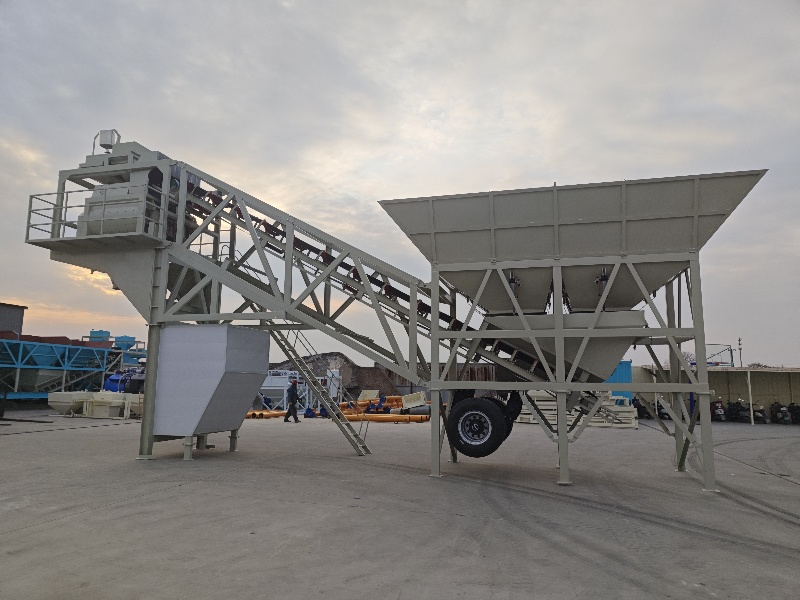
1. Produce Concrete Closer to the Pouring Site
Transportation is one of the most important cost differences between centralized ready-mix supply and on-site concrete production.
When concrete is purchased from a distant commercial plant, contractors may need to pay for:
Mixer-truck transportation
Fuel consumption
Driver time
Road tolls
Truck waiting time
Additional trucks during peak pouring periods
Returned or rejected concrete
Delays caused by traffic or supplier scheduling
A mobile concrete batching plant can be installed directly at or near the construction site. This shortens the distance between production and placement, reducing dependence on long-distance mixer-truck delivery.
Shengmao mobile batching plants are designed for projects where production locations change over time. Available systems can be transported between sites and configured for on-site concrete production in capacities from approximately 20 to 100 m³/h.
Projects That Benefit Most
On-site mobile batching is particularly valuable for:
Highway and expressway construction
Bridge projects
Railway and metro construction
Airport construction
Hydropower and dam projects
Wind farm foundations
Mining and quarry projects
Remote industrial facilities
Large residential developments
Temporary precast yards
Projects located far from commercial ready-mix suppliers
The greater the distance from the external concrete supplier, the more significant the potential transportation and scheduling savings may become.
2. Reduce Concrete Delivery Delays
The cost of delayed concrete is not limited to the price of the material.
A late mixer truck can leave workers, pumps, cranes and finishing teams waiting. For large continuous pours, an interrupted supply can also affect construction quality and create additional rework.
Producing concrete near the placement area allows the project team to coordinate production with actual site demand.
This can reduce:
Concrete-pump idle time
Labor waiting time
Delays between batches
Dependence on third-party delivery schedules
Risk of concrete arriving outside the required workability window
Emergency ordering from alternative suppliers
A mobile plant is especially useful where road conditions, traffic congestion or remote access make external concrete delivery unpredictable.
3. Lower Foundation and Installation Costs
A traditional stationary concrete batching plant may require substantial civil works, including reinforced concrete foundations for the mixer structure, aggregate bins, cement silos and supporting equipment.
These foundations add costs for:
Site excavation
Reinforcement steel
Concrete
Formwork
Civil engineering
Construction labor
Foundation curing
Equipment anchoring
Future demolition
Some mobile batching plant configurations use integrated steel structures and horizontal cement silos, reducing or eliminating the need for large permanent foundations.
Foundation-free does not mean that the plant can be placed on any surface. The site should still be:
Firm and properly compacted
Level
Well drained
Capable of supporting the operating load
Accessible to aggregate loaders and cement-delivery trucks
Suitable for local safety and environmental requirements
Correct site preparation prevents settlement, misalignment and drainage problems that could later increase maintenance costs.
4. Avoid Rebuilding a Plant for Every Project
Contractors operating across multiple project locations may not obtain sufficient value from a permanent plant that remains at one completed site.
A mobile concrete batching plant can be transferred to the next project, allowing the same equipment investment to serve several contracts.
Reusable plant components may include:
Main mixing unit
Aggregate batching system
Weighing equipment
Control cabin
Water and admixture systems
Air compressor
Screw conveyors
Horizontal cement silos
Dust-collection equipment
This improves asset utilization and spreads the original equipment investment across a larger total volume of concrete.
Before selecting a plant, contractors should evaluate:
Expected number of relocations
Distance between projects
Local transport restrictions
Crane requirements
Number of transport vehicles required
Assembly and disassembly time
Foundation requirements at each location
A plant advertised as “mobile” may still require considerable dismantling and civil work. Buyers should therefore evaluate the complete relocation process rather than the product name alone.
5. Select the Correct Production Capacity
Oversizing and undersizing can both increase concrete batching plant operating costs.
An oversized mobile concrete plant may result in:
Higher initial investment
Greater installed motor power
Larger generators or transformers
More expensive transportation
Higher spare-parts inventory
Low equipment utilization
Unnecessary maintenance expenses
An undersized plant may result in:
Continuous operation at maximum load
Longer pouring schedules
Mixer-truck and pump waiting
Accelerated component wear
Overtime labor
Inability to meet peak concrete demand
The plant should be selected according to realistic required output—not only theoretical hourly capacity.
Basic Capacity Calculation
Use the following calculation as a starting point:
Required plant capacity = Daily concrete demand ÷ Available production hours ÷ Expected utilization rate
The utilization rate should account for:
Material loading
Mix changes
Cleaning
Routine inspections
Operator breaks
Truck positioning
Minor production interruptions
Do not assume that a plant will achieve its theoretical output every hour of every shift.
Example Mobile Plant Capacity Range
| Project Requirement | Possible Capacity Direction | Typical Considerations |
|---|---|---|
| Small temporary projects | 20–30 m³/h | Lower investment and easier transportation |
| Residential and municipal work | 25–50 m³/h | Moderate output and flexible deployment |
| Roads, bridges and commercial construction | 50–75 m³/h | Higher continuous concrete demand |
| Large infrastructure projects | 75–100 m³/h | Greater storage, loading and logistics requirements |
Shengmao’s mobile range includes YHZM, NYHZS and YHZS configurations with different mixers, discharge heights, installed power levels and foundation requirements. The correct model should be based on required concrete type, hourly demand and site layout rather than capacity alone.
6. Use Accurate Weighing to Reduce Material Waste
Cement is generally one of the highest-value raw materials used in concrete production. Even a small repeated overdosage can significantly increase the cost per cubic meter over a large project.
Inaccurate batching can also cause:
Inconsistent concrete strength
Excessive cement consumption
Incorrect water-cement ratio
Variation in slump
Rejected batches
Additional testing
Rework
Customer complaints
Modern mobile batching plants use separate weighing systems for aggregates, cement, water and admixtures.
Shengmao mobile plant specifications list aggregate weighing accuracy of approximately ±2% and cement, water and admixture weighing accuracy of approximately ±1% for several YHZM, NYHZS and YHZS models. Actual performance depends on correct installation, calibration, material flow and maintenance.
Ways to Maintain Batching Accuracy
Operators should:
Calibrate weighing systems at scheduled intervals
Check whether load cells return to zero
Remove material buildup around weighing hoppers
Inspect flexible connections
Prevent cement or aggregate from bridging
Check water-meter and admixture-pump accuracy
Use moisture compensation where appropriate
Restrict unauthorized recipe changes
Record actual material consumption by batch
Material consumption reports should be compared with the approved mix design. Persistent differences can indicate calibration problems, leakage, operator error or uncontrolled moisture variation.
7. Control Aggregate Moisture
Aggregate moisture affects the actual amount of water entering the concrete.
If moisture is ignored, operators may add too much water, reducing concrete consistency and potentially increasing the need for corrective cement or admixture additions.
Poor moisture control may lead to:
Slump variation
Inconsistent strength
Longer mixing adjustments
Rejected concrete
Excess water consumption
Incorrect material-cost calculations
To improve moisture control:
Store sand and aggregates on a properly drained surface
Separate different aggregate sizes
Protect fine aggregate from heavy rain where possible
Test moisture regularly
Update moisture values in the control system
Use moisture sensors when justified by production volume
Recheck the mix after significant weather changes
Accurate moisture management reduces both quality risk and unnecessary material consumption.
8. Reduce Labor Through Automation
Manual batching requires workers to measure, record and control multiple materials. This increases labor requirements and creates more opportunities for error.
An automated mobile concrete batching plant can integrate:
Recipe selection
Aggregate weighing
Cement weighing
Water dosing
Admixture dosing
Mixing-time control
Discharge control
Batch reporting
Production data storage
Automation allows a smaller operating team to manage production while improving repeatability.
However, automation does not eliminate the need for trained personnel. A cost-efficient team still needs to understand:
Concrete mix requirements
Equipment startup and shutdown
Alarm handling
Calibration
Preventive maintenance
Material inventory
Quality-control procedures
Safe cleaning and lockout practices
The most effective cost reduction comes from combining automation with operator training—not from reducing staffing below safe operating levels.
9. Monitor Energy Consumption per Cubic Meter
Comparing only total daily electricity consumption can be misleading. A plant producing more concrete will normally use more total energy.
The more useful indicator is:
Energy cost per cubic meter = Total energy cost ÷ Saleable concrete output
Record energy use for:
Mixer motors
Belt conveyors
Screw conveyors
Air compressor
Water pumps
Heating or cooling systems
Dust collectors
Lighting and control systems
Standby generator operation
The installed power differs considerably by model. For example, Shengmao lists total power from approximately 42 to 77.5 kW for selected YHZM configurations and approximately 60 to 102 kW for selected YHZS configurations. These figures should be evaluated together with actual output, mixer type and operating conditions.
Practical Energy-Saving Measures
Avoid running conveyors and mixers while production is stopped
Repair compressed-air leaks
Maintain correct belt alignment and tension
Prevent overloaded mixers
Keep electric motors and cooling systems clean
Sequence production to reduce repeated startup and shutdown
Use appropriately sized generators
Track idle energy separately
Compare energy consumption between shifts
Investigate sudden increases in kWh per cubic meter
A cheaper plant with poor production efficiency may consume more energy per saleable cubic meter than a properly sized, well-maintained system.
10. Reduce Mixer-Truck Requirements
A distant concrete source may require a larger fleet of transit mixers to maintain continuous supply.
When the batching plant is located close to the pour, each truck can complete more delivery cycles within the same shift.
This may reduce:
Number of trucks required
Fuel consumption
Driver hours
Fleet rental costs
Truck maintenance
Concrete residue inside drums
Waiting at the batching plant
Waiting at the construction site
The actual saving depends on haul distance, loading time, unloading time, road conditions and pour rate.
Before purchasing a mobile plant, calculate the required truck fleet under both scenarios:
Required trucks = Total truck cycle time ÷ Required interval between deliveries
The cycle should include loading, travel, site waiting, unloading, return travel and drum washing.
11. Improve Material Logistics and Inventory Control
A mobile plant relocates concrete production, but raw materials must still be supplied efficiently.
Poor logistics can eliminate the cost advantages of on-site batching.
Plan:
Cement-delivery frequency
Aggregate stockpile size
Loader capacity
Water availability
Admixture storage
Fuel or electrical supply
Access for delivery vehicles
Backup suppliers
Minimum safety stock
Installing excessively large storage systems increases transportation and capital costs. Installing insufficient storage creates production interruptions.
The goal is to maintain enough inventory for uninterrupted production without creating unnecessary stock or material deterioration.
12. Produce Only the Concrete Required
Overproduction creates direct losses because excess concrete may be difficult to reuse.
Common causes include:
Inaccurate quantity estimates
Large minimum delivery volumes
Poor communication between the plant and pouring team
Last-minute design changes
Conservative ordering
Uncontrolled production near the end of a pour
An on-site mobile concrete plant allows production to respond more closely to actual consumption.
Near the end of a pour, the batch size can be adjusted according to the remaining requirement. This helps reduce returned concrete, disposal costs and mixer-truck cleaning.
Operators should maintain communication between:
Batching-plant control room
Site supervisor
Concrete pump operator
Quality-control team
Formwork team
Production should slow before the final calculated volume rather than continuing at full capacity until the pour is complete.
13. Establish Preventive Maintenance Routines
Unexpected breakdowns are usually more expensive than planned maintenance.
A plant failure during a major pour can create costs related to:
Idle labor
Pump standby
Emergency spare parts
Technician travel
Concrete disposal
Equipment rental
Project delays
Structural construction joints
Overtime work
Preventive maintenance should cover the mixer, conveyor system, cement silo, screw conveyor, pneumatic system, weighing equipment and control cabinet.
Shengmao’s batching plant maintenance guidance recommends daily mixer cleaning, lubrication checks, weighing-system inspection, belt monitoring, dust-filter cleaning, air-system inspection and scheduled checking of wear parts.
Daily Checks
Clean the mixer and discharge gate
Inspect mixer shaft seals
Check lubrication levels
Drain water from the air tank
Check load-cell zero readings
Inspect for air and water leaks
Remove material buildup
Listen for unusual noise
Confirm emergency-stop functions
Weekly and Monthly Checks
Inspect mixing blades and liners
Check conveyor belt tension and alignment
Inspect rollers and belt scrapers
Clean silo dust filters
Check screw-conveyor connections
Inspect gearbox oil levels
Test admixture pumps
Tighten electrical terminals
Verify weighing calibration
Maintenance records allow managers to identify repeated failures and replace components before they cause extended downtime.
14. Keep Critical Spare Parts on Site
A relatively inexpensive component can stop the entire plant if no replacement is available.
Critical spare parts may include:
Mixer blades
Mixer liners
Shaft seals
Load cells
Limit switches
Solenoid valves
Air-cylinder seals
Conveyor rollers
Belt scrapers
Electrical contactors
Sensors
Admixture-pump components
Screw-conveyor bearings
The spare-parts plan should be based on:
Plant model
Operating hours
Local supplier availability
International delivery time
Wear rate
Project importance
Environmental conditions
Remote projects should carry a larger critical-parts inventory because emergency shipping may be expensive and slow.
15. Train Operators to Prevent Avoidable Costs
Many plant expenses are caused by incorrect operation rather than equipment design.
Examples include:
Starting a loaded mixer
Allowing concrete to harden inside the mixer
Operating with insufficient lubrication
Ignoring abnormal noise
Running a misaligned conveyor belt
Changing recipes without authorization
Overfilling aggregate bins
Failing to drain compressed-air systems
Using incorrect cleaning procedures
Operator training should include equipment operation, basic concrete technology, maintenance inspection, troubleshooting, data recording and safety.
Training more than one employee is also important. Production should not depend entirely on a single operator.
How to Calculate the Real Cost per Cubic Meter
Use the following formula:
Total operating cost per m³ =
Raw material cost
energy cost
labor cost
equipment maintenance cost
plant relocation and installation cost
material transportation cost
concrete delivery cost
quality-control cost
waste and rejected-concrete cost
downtime cost
Divide total project-related operating expenses by the volume of compliant, usable concrete—not by theoretical production capacity.
Compare Three Supply Scenarios
Before investing, compare:
| Cost Item | External Ready-Mix Supply | Mobile Batching Plant | Stationary Batching Plant |
|---|---|---|---|
| Concrete transport distance | Usually higher | Low | Depends on location |
| Initial equipment investment | Low | Medium | High |
| Foundation requirement | None for buyer | Low to medium | Usually high |
| Relocation flexibility | Not applicable | High | Low |
| Production control | Limited | High | High |
| Suitability for temporary projects | Medium | High | Low |
| Suitability for long-term high-volume supply | Depends on supplier | Medium to high | High |
| Dependence on external suppliers | High | Low | Low |
The cheapest option depends on project volume, duration, location and production schedule.
When Is a Mobile Plant Not the Lowest-Cost Option?
A mobile concrete batching plant is not automatically the best choice for every operation.
A stationary plant may offer a better lifecycle cost when:
The production location will remain unchanged for many years
Continuous high-volume production is required
Large aggregate and cement storage is necessary
The plant supplies a permanent regional market
Relocation has little business value
Extremely high output is more important than mobility
Purchasing ready-mix concrete may remain more economical when:
The required volume is very small
A reliable supplier is located nearby
Concrete is needed only occasionally
The project cannot obtain plant permits
There is insufficient space for raw-material storage
The project lacks trained operators
The decision should be based on total lifecycle cost and operational risk rather than equipment price alone.
How to Select a Cost-Efficient Mobile Concrete Batching Plant
Before requesting a quotation, prepare the following information:
Required concrete output per hour and per day
Total estimated concrete volume
Project duration
Number of expected relocations
Required concrete types and strength grades
Maximum aggregate size
Number of aggregate fractions
Available electrical supply
Generator requirements
Cement-silo capacity
Required discharge height
Local transport restrictions
Site temperature and climate
Foundation conditions
Dust-control and environmental requirements
Required automation level
Available installation equipment
Local spare-parts availability
A supplier can then recommend a configuration based on actual production conditions instead of offering an oversized standard package.
Frequently Asked Questions
Does a mobile concrete batching plant reduce concrete transportation costs?
Yes. Installing the plant near the pouring area reduces the distance between concrete production and placement. This can reduce transit-mixer fuel consumption, driver hours, fleet requirements and delivery delays.
How does a mobile batching plant reduce installation costs?
Some mobile plants use integrated structures and horizontal cement silos that require less permanent foundation work. This reduces civil construction and makes later relocation easier.
What mobile concrete plant capacity should I choose?
Capacity should be based on peak concrete demand, available working hours, truck cycle time and realistic equipment utilization. Do not select a plant solely according to theoretical hourly output.
Can automation reduce material costs?
Automated weighing and recipe control can reduce manual dosing errors, cement overuse and inconsistent water addition. The system must still be regularly calibrated and properly maintained.
How can energy costs be reduced?
Track energy consumption per cubic meter, prevent unnecessary idling, repair compressed-air leaks, maintain motors and conveyors, avoid mixer overload and select a plant that matches actual production demand.
Is preventive maintenance expensive?
Preventive maintenance creates a planned cost, but it helps avoid larger expenses caused by emergency repairs, production stoppages, idle labor and delayed concrete pours.
Mobile or stationary batching plant: which is more economical?
A mobile plant is generally more suitable for temporary, remote or multi-site projects. A stationary plant may be more economical for permanent, high-volume production at one location.
Conclusion
A mobile concrete batching plant can reduce operating costs by moving production closer to the construction site, shortening concrete delivery distances, reducing installation work and allowing the same equipment to serve multiple projects.
The greatest savings usually come from combining mobility with disciplined plant management:
Select the correct capacity
Control material weighing
Monitor aggregate moisture
Reduce idle energy consumption
Coordinate production with actual pouring demand
Maintain critical components
Train operators
Keep essential spare parts available
Measure the real cost per cubic meter
Contact Shengmao with your required hourly capacity, concrete type, project location, working schedule and relocation requirements to receive a suitable mobile batching plant recommendation.