
Why Are Stationary Concrete Batching Plants Essential for Precast Concrete Production?
Precast concrete manufacturing depends on repeatability.
Every beam, wall panel, slab, column, pipe, paving block or structural component must meet defined requirements for strength, dimensions, surface quality, workability and curing performance. Unlike general construction concrete, precast concrete is produced in a controlled factory environment and is often placed into highly engineered molds using automated or semi-automated equipment.
This means that fluctuations in aggregate moisture, cement dosage, water content, admixture quantity or mixing time can affect not just one truckload of concrete, but an entire sequence of manufactured components.
A properly configured stationary concrete batching plant provides the weighing accuracy, intensive mixing, production stability, recipe control and automation required by medium- and large-scale precast concrete factories.
For manufacturers operating a permanent production facility, the batching plant is not simply a machine for making concrete. It is the central production system connecting raw material storage, concrete mixing, mold filling, casting, curing and quality control.
What Is a Stationary Concrete Batching Plant?
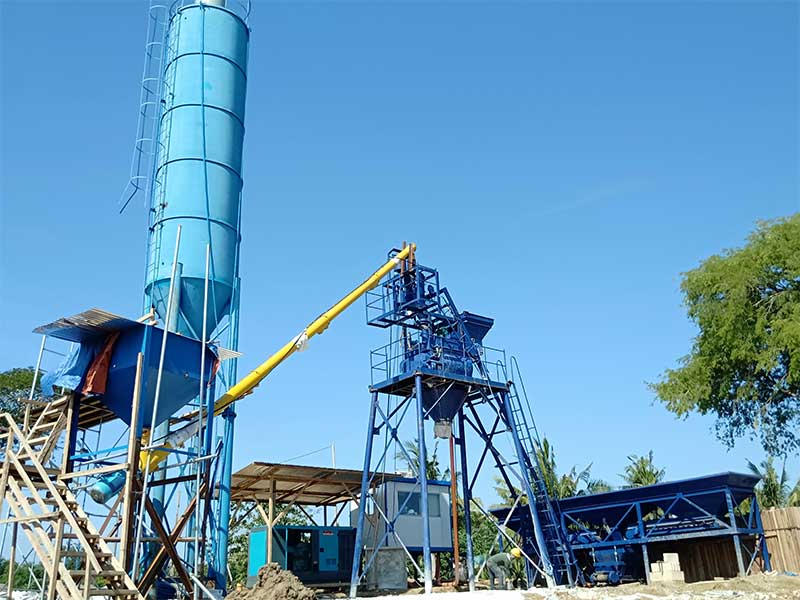
A stationary concrete batching plant is a permanently installed concrete production system designed for continuous or high-frequency operation at one location.
A typical stationary plant includes:
Aggregate storage bins
Aggregate weighing hoppers
Belt conveyor or skip hoist feeding system
Cement and supplementary powder silos
Screw conveyors
Cement weighing equipment
Water weighing equipment
Admixture dosing systems
Concrete mixer
Moisture measurement equipment
Pneumatic system
Dust collection equipment
Computerized control system
Concrete discharge and distribution system
Unlike a mobile plant, a stationary batching plant is designed around the long-term production layout of the precast factory. Its foundations, storage capacity, mixer position, discharge height and material transport system can be coordinated with the molds, casting machines, concrete buckets, flying buckets or distribution equipment used inside the factory.
Stationary plants are commonly selected for long operating hours, high production capacity and large infrastructure or precast concrete projects.
Why Is Precast Concrete Production More Demanding?
Ready-mix concrete is normally produced at a batching plant, loaded into a transit mixer and transported to a construction site. The truck drum can continue mixing the concrete during transportation.
Precast concrete follows a different production process.
The concrete may be discharged directly into:
A concrete bucket
A flying bucket
A concrete distributor
A casting machine
A pipe production machine
A block or paver machine
A fixed structural mold
The concrete therefore needs to leave the mixer with the required consistency and homogeneity immediately.
There may be little or no additional mixing after discharge.
Precast factories also frequently produce stiff, low-slump or zero-slump concrete. These mixes are used because they can support rapid mold filling, vibration, compaction, demolding and dimensional control. However, they are generally more difficult to mix uniformly than conventional flowing concrete.
Batching and mixing equipment must therefore be selected according to the mix design, mixer capacity, concrete consistency and required production cycle. The National Precast Concrete Association identifies correct batching and mixing equipment as a fundamental part of efficient precast plant performance.
1. Precise Material Weighing Protects Product Consistency
A precast concrete product is manufactured from a controlled formula.
The batching plant must measure:
Coarse aggregates
Fine aggregates
Cement
Fly ash
Slag or other supplementary materials
Water
Plasticizers
Accelerators
Retarders
Pigments
Fibers
Other additives
Even when the same recipe is selected, actual material conditions can change during the day. Sand moisture may increase after rain, aggregate grading may vary between deliveries, and material flow characteristics may change as storage bins empty.
A stationary concrete batching plant uses load cells and separate weighing systems to control the quantity of each material entering the mixer.
This helps the precast manufacturer maintain:
Stable water-cement ratio
Repeatable compressive strength
Consistent workability
Predictable setting time
Uniform surface appearance
Reliable demolding performance
Reduced variation between production batches
For structural components, repeatability is especially important because the plant may produce hundreds of elements according to the same engineering specification.
A small dosing error repeated over many batches can lead to widespread quality problems, mold delays or rejected products.
2. Intensive Mixing Produces More Homogeneous Concrete
Accurate weighing alone does not guarantee high-quality concrete. The ingredients must also be distributed uniformly throughout the entire batch.
Precast mixes may contain:
High cement content
Fine mineral powders
Low water content
Fibers
Pigments
Multiple chemical admixtures
Lightweight aggregates
Recycled materials
These components can be difficult to distribute evenly, particularly when producing low-slump or high-strength concrete.
Stationary precast batching plants normally use forced-action mixers rather than basic drum mixers. Common options include twin-shaft, planetary and pan mixers.
The mixer generates controlled material movement so that cement paste, aggregates, water and additives are dispersed throughout the batch.
A homogeneous mix helps reduce:
Uneven strength
Dry material pockets
Aggregate segregation
Inconsistent color
Fiber clustering
Poor mold filling
Surface defects
Variable curing behavior
The most suitable mixer depends on the product, batch size and concrete formulation.
3. Different Mixer Types Support Different Precast Products
The concrete mixer is the core component of a precast batching plant. There is no single mixer type that is ideal for every precast product.
Planetary Concrete Mixer
A planetary mixer creates intensive multidirectional movement within the mixing pan.
It is often considered for:
Architectural precast concrete
Colored concrete
Paving blocks
Concrete roof tiles
Small structural components
Fiber-reinforced concrete
Products requiring uniform appearance
Its mixing action can help distribute pigments, fine powders and fibers throughout relatively small or medium-sized batches.
Twin-Shaft Concrete Mixer
A twin-shaft mixer uses two horizontal shafts with mixing arms and blades.
It is commonly considered for:
Precast beams
Columns
Wall panels
Floor slabs
Large structural elements
High-strength concrete
High-output production lines
Twin-shaft mixers are suitable when the precast factory requires intensive mixing and relatively large batch volumes.
Pan Mixer
A pan mixer can be used for a wide variety of precast and concrete product applications.
Depending on its design, it may be considered for:
Concrete blocks
Pavers
Pipes
Manholes
Small precast elements
Low-slump concrete
Dry or semi-dry mixes
Mixer selection should consider more than nominal hourly capacity. The manufacturer should evaluate batch size, filling level, mixing time, discharge time, cleaning requirements and the behavior of the actual concrete recipe.
SHENGMAO’s concrete batching plant configurations can use twin-shaft, pan or planetary mixers according to the production requirements.
4. Aggregate Moisture Control Maintains the Correct Water Content
Aggregate moisture is one of the most important variables in concrete production.
Sand can contain a significant amount of water, particularly when it is stored outdoors. If this moisture is not considered, the total water entering the mixer may exceed the recipe target.
For example, the control system may add the programmed quantity of water without accounting for water already present in the sand. This can increase the effective water-cement ratio and change concrete strength, consistency and setting behavior.
A stationary precast concrete batching plant can be equipped with:
Sand moisture probes
Aggregate moisture sensors
Mixer moisture sensors
Automatic water compensation
Real-time moisture calculation
Operator moisture correction functions
The control system uses moisture measurements to adjust the added water and, where required, the wet weight of the aggregates.
Automatic sand moisture measurement and compensation are commonly incorporated into precast batching systems to improve recipe consistency.
This is particularly valuable for low-slump concrete, where even a relatively small change in water content can noticeably affect compaction, mold filling and demolding.
5. Stable Production Cycles Keep the Precast Line Moving
A precast factory is a coordinated manufacturing system.
The batching plant must supply concrete at the correct time to match:
Mold preparation
Reinforcement placement
Prestressing operations
Concrete distribution
Vibration and compaction
Surface finishing
Curing
Demolding
Pallet circulation
If the concrete plant produces too slowly, casting equipment and workers may remain idle.
If it produces too quickly, fresh concrete may wait too long before placement. This can affect consistency, setting behavior and surface finish.
A stationary batching plant can be designed around the required factory cycle.
Important production variables include:
Required concrete volume per mold
Mixer batch size
Number of batches per component
Mixing time
Discharge time
Concrete transport time
Mold filling time
Number of casting stations
Shift output target
For example, a factory producing large wall panels may require fewer but larger batches. A paver plant may require smaller batches at a much higher frequency.
The batching plant should therefore be matched to the actual casting process rather than selected only according to a theoretical cubic-meter-per-hour rating.
6. Automation Reduces Recipe and Operator Errors
Modern precast factories may use many concrete formulations.
Different recipes may be required for:
Structural concrete
Architectural concrete
Colored products
High-early-strength concrete
Self-compacting concrete
Fiber-reinforced concrete
Lightweight concrete
Low-slump products
Exposed aggregate finishes
Manual material dosing would make it difficult to switch between these formulations consistently.
A computerized batching control system can store recipes and automatically manage:
Material selection
Target weights
Weighing tolerances
Dosing sequence
Mixer loading sequence
Mixing time
Water correction
Admixture dosing
Discharge timing
Production reports
Batch alarms
Automation systems designed for precast plants can receive material measurements, adjust component flow and coordinate concrete delivery equipment with the casting process.
This reduces dependence on operator memory and helps ensure that the approved formula is followed for every production batch.
Operators are still important. They monitor the system, check raw material conditions, respond to alarms and verify concrete quality. However, automation gives them more reliable information and reduces repetitive manual operations.
7. Batch Records Improve Quality Traceability
Precast components may be manufactured for bridges, industrial buildings, railway systems, utility networks, residential projects and other engineered structures.
The manufacturer may need to demonstrate how the concrete was produced.
A computerized stationary batching plant can record information such as:
Recipe identification
Production date and time
Material target weights
Actual material weights
Weighing deviations
Moisture corrections
Mixing duration
Operator information
Alarm records
Batch number
Production quantity
These records can be linked to:
Mold numbers
Component identification
Reinforcement records
Curing data
Laboratory test results
Project documentation
If a quality issue is discovered, the manufacturer can review the relevant batch data rather than relying only on handwritten production notes.
Traceability does not replace concrete testing, but it provides valuable evidence for process control, audits and problem investigation.
8. Larger Material Storage Supports Continuous Production
Precast factories normally operate from a permanent site and may produce throughout one or more shifts.
A stationary plant can accommodate larger raw material storage systems than many mobile or compact plants.
These may include:
Multiple aggregate bins
Large aggregate storage compartments
Separate sand and stone grading
Multiple cement silos
Fly ash silos
Slag powder silos
Pigment dosing systems
Fiber dosing systems
Multiple admixture tanks
Recycled water storage
Larger storage capacity reduces the risk of production interruptions caused by frequent material replenishment.
Separate storage also allows the factory to produce different concrete formulations without mixing incompatible materials.
When planning storage capacity, the manufacturer should consider:
Daily concrete production
Material consumption per cubic meter
Delivery truck capacity
Supplier delivery frequency
Reserve stock requirements
Number of concrete recipes
Available factory space
Local weather conditions
The objective is not simply to install the largest possible silos. The storage system must support the required production volume while maintaining material quality and efficient replenishment.
9. Stationary Plants Integrate More Easily with Concrete Distribution Systems
After mixing, the concrete must move from the mixer to the correct production station.
Precast factories may use:
Concrete buckets
Rail-mounted buckets
Flying buckets
Overhead distribution systems
Belt conveyors
Casting machines
Concrete distributors
Direct mixer discharge
Because a stationary plant remains in a fixed position, the mixer discharge point can be coordinated with the concrete transport system.
This makes it possible to optimize:
Discharge height
Bucket position
Travel route
Distribution speed
Number of delivery units
Cleaning access
Safety clearances
Communication with the casting line
In an automated factory, the batching system may receive production instructions and prepare the required concrete recipe for a specific pallet, mold or production station.
Software and control systems can connect concrete batching with the broader automated precast production process.
10. Stationary Plants Support Environmental and Dust Control
Concrete production involves powder materials, fine aggregates and material transfer points that can generate dust.
A permanent plant can be equipped with environmental control systems such as:
Cement silo dust collectors
Enclosed screw conveyors
Enclosed aggregate conveyors
Mixer dust extraction
Loading-point dust collection
Covered aggregate storage
Centralized wastewater collection
Concrete recycling systems
Mixer washing systems
Noise-reduction enclosures
Because the plant layout remains fixed, ducts, water lines, drainage systems and enclosures can be integrated into the factory design.
This can improve:
Workplace cleanliness
Material recovery
Equipment protection
Operator visibility
Maintenance conditions
Compliance with local environmental requirements
The exact environmental configuration should be selected according to local regulations, surrounding land use and raw material handling conditions.
11. Permanent Installation Allows More Customized Plant Design
Mobile batching plants prioritize transportation and relocation. Their dimensions and component layout are influenced by chassis size and shipping restrictions.
Stationary plants provide greater design flexibility.
The system can be configured according to:
Factory building dimensions
Available land
Required production capacity
Number of aggregate materials
Mixer type
Number of mixers
Discharge method
Material storage requirements
Future expansion plans
Local voltage
Climate
Environmental regulations
Automation level
A precast plant may use one mixer for all products, or separate mixers for different production lines.
Possible configurations include:
Single-Mixer Configuration
Suitable when one mixer can supply all molds and products within the required cycle.
Dual-Mixer Configuration
Suitable when the factory needs:
Higher output
Separate concrete types
Independent production lines
Backup mixing capacity
Reduced recipe cross-contamination
One mixer might produce conventional structural concrete while another produces colored, high-strength or low-slump concrete.
Tower-Type Configuration
Raw materials are elevated and moved downward through weighing and mixing equipment.
This can reduce horizontal material transport and support high-output production, although it normally requires a larger initial investment and taller plant structure.
Belt Conveyor Configuration
Aggregates are transported continuously by belt conveyor.
This configuration is generally considered for larger aggregate volumes, higher production requirements and continuous operation.
Stationary vs. Mobile Batching Plants for Precast Production
| Comparison Factor | Stationary Batching Plant | Mobile Batching Plant |
|---|---|---|
| Primary purpose | Permanent concrete production | Temporary or relocatable production |
| Typical production scale | Medium to high | Small to medium |
| Raw material storage | Larger and more customizable | More limited |
| Mixer options | Wide selection | Influenced by mobile layout |
| Automation integration | High | Moderate to high |
| Concrete distribution integration | Easier to customize | More restricted |
| Foundation requirement | Normally required | Reduced or model-dependent |
| Installation time | Longer | Shorter |
| Relocation | Not designed for frequent movement | Designed for relocation |
| Future expansion | Easier to plan into the layout | More limited |
| Best application | Long-term precast factory | Temporary projects or changing sites |
A mobile plant is not inherently unsuitable for precast production.
It can work well for:
Temporary precast yards
Remote infrastructure projects
Pilot production
Low-volume operations
Projects requiring relocation
Which Precast Products Can a Stationary Plant Produce Concrete For?
A properly configured stationary batching plant can support concrete production for many product categories.
Structural Precast Components
Beams
Columns
Wall panels
Floor slabs
Staircases
Balconies
Foundation elements
Prestressed components
These products often require controlled structural concrete, reliable strength development and accurate batch records.
Infrastructure Components
Bridge beams
Box culverts
Drainage channels
Railway sleepers
Tunnel segments
Highway barriers
Utility vaults
Retaining wall elements
Infrastructure products may use high-strength, low-permeability or specialized concrete formulations.
Concrete Pipes and Manholes
Reinforced concrete pipes
Drainage pipes
Manholes
Inspection chambers
Pipe fittings
Box culverts
These production lines may require stiff concrete that can be compacted rapidly inside specialized molds.
Blocks, Pavers and Masonry Products
Concrete blocks
Interlocking pavers
Kerbstones
Landscaping blocks
Permeable pavers
Concrete tiles
These products commonly use low-moisture or semi-dry concrete and require consistent material distribution for reliable compaction.
Architectural Precast Products
Decorative panels
Facade elements
Colored concrete products
Exposed aggregate panels
Artificial stone
Customized landscape elements
Architectural production places additional importance on pigment dosing, surface appearance and batch-to-batch color consistency.
How to Select a Stationary Batching Plant for a Precast Factory
The correct plant cannot be selected from production capacity alone.
Manufacturers should evaluate the complete production process.
1. Identify the Precast Products
Determine whether the factory will produce:
Large structural elements
Small concrete products
Pipes
Blocks
Pavers
Prestressed components
Architectural products
Multiple product categories
The product determines the concrete type, mixer and discharge system.
2. Define the Required Concrete Recipes
Provide information about:
Concrete strength
Slump
Water-cement ratio
Aggregate size
Cement type
Supplementary materials
Fibers
Pigments
Chemical admixtures
Required mixing time
Actual recipes provide more useful selection information than a general statement such as “we need 60m³/h.”
3. Calculate the Production Cycle
Determine:
Concrete volume per product
Products per hour
Concrete volume per shift
Number of casting lines
Time between mold fillings
Peak concrete demand
The mixer and batching system must satisfy peak demand, not just average daily consumption.
4. Select the Mixer Type and Batch Size
The mixer should be matched to the concrete consistency and required batch volume.
Consider:
Twin-shaft mixer
Planetary mixer
Pan mixer
Mixer filling volume
Mixing time
Discharge speed
Number of discharge gates
Maintenance access
Cleaning requirements
5. Plan the Raw Material System
Confirm:
Number of aggregate bins
Aggregate bin volume
Cement silo quantity
Silo capacity
Number of powder materials
Admixture tank quantity
Pigment or fiber dosing requirements
Material replenishment route
6. Design the Concrete Delivery Method
Determine how concrete will move from the mixer to the molds.
The plant supplier should know:
Discharge height
Bucket volume
Bucket travel distance
Number of casting stations
Required delivery cycle
Whether flying buckets are used
Whether direct discharge is possible
7. Define Automation and Reporting Requirements
Specify whether the factory needs:
Recipe storage
User permission levels
Automatic moisture compensation
Production scheduling
Batch reports
Remote diagnostics
ERP connection
Mold or pallet identification
Quality-control data export
8. Consider Future Expansion
A factory may start with one production line and add another later.
The original plant layout can reserve space or capacity for:
Additional cement silos
More aggregate bins
A second mixer
Another concrete bucket
New admixture systems
An additional casting line
Planning expansion during the original design is usually easier than modifying a crowded plant after production begins.
Common Mistakes When Choosing a Precast Concrete Batching Plant
Selecting Capacity from Cubic Meters per Hour Alone
Nominal plant capacity does not explain whether the plant can match the actual mold filling schedule.
Batch volume and cycle time are often more important for precast production.
Choosing the Wrong Mixer
A mixer suitable for flowing ready-mix concrete may not deliver the required performance for stiff, colored or fiber-reinforced precast concrete.
Ignoring Aggregate Moisture
Without reliable moisture measurement and correction, water content can vary even when the programmed recipe remains unchanged.
Underestimating Concrete Distribution Time
A fast mixer provides limited value if the bucket or distribution system cannot deliver concrete to the casting station at the same rate.
Installing Insufficient Material Storage
Small aggregate bins or cement silos can cause frequent interruptions and reduce effective plant output.
Overlooking Cleaning and Maintenance Access
Mixer maintenance, scale calibration and conveyor inspection must be considered in the plant layout.
Failing to Plan for Additional Recipes
Future products may require pigments, fibers, extra powder materials or different admixtures. The control and dosing system should allow reasonable expansion.
Are Stationary Batching Plants Essential for Every Precast Factory?
Not every precast operation requires a large stationary batching plant.
A compact or mobile system may be more economical for:
Low daily production
Temporary manufacturing
Limited product variety
Pilot projects
Frequently changing production locations
However, a stationary concrete batching plant becomes increasingly important when the factory has:
Long-term production plans
Multiple daily shifts
High concrete demand
Several product recipes
Strict quality requirements
Automated casting equipment
Large raw material consumption
Extensive production records
Multiple molds or production lines
In these conditions, the stationary plant provides the stable foundation required for industrial precast manufacturing.
Conclusion
Precast concrete production is a manufacturing process, not simply a concrete supply operation.
The batching plant must repeatedly produce the correct concrete at the correct time and deliver it to the correct production station.
A well-designed stationary concrete batching plant helps precast manufacturers achieve:
Accurate material dosing
Homogeneous concrete mixing
Stable water content
Repeatable product quality
Predictable production cycles
Automated recipe control
Batch traceability
Reliable material supply
Integration with casting equipment
Long-term production scalability
The right plant should be designed around the precast product, concrete recipe, mold cycle, mixer requirements and factory layout.
SHENGMAO can configure stationary concrete batching plants with skip hoist or belt feeding, twin-shaft, planetary or pan mixers, computerized control systems and customized material storage equipment.
Frequently Asked Questions
What type of batching plant is best for precast concrete?
A stationary wet-mix batching plant is usually recommended for long-term medium- or large-scale precast production. It provides controlled weighing, central mixing and direct delivery of fully mixed concrete to the casting line.
Can a stationary batching plant produce low-slump concrete?
Yes. The plant can produce low-slump or semi-dry concrete when equipped with a suitable forced-action mixer, accurate water dosing and appropriate material feeding systems.
Which mixer is best for precast concrete?
The answer depends on the product.
Twin-shaft mixers are commonly considered for large structural components and high-output production. Planetary mixers are often selected for architectural products, colored concrete and applications requiring intensive multidirectional mixing. Pan mixers are widely used for blocks, pavers, pipes and other low-slump products.
Why is moisture control important in precast production?
Water already contained in sand and aggregates contributes to the total water in the concrete. Without moisture correction, the actual water-cement ratio may differ from the approved recipe, affecting strength, consistency and demolding.
Can one batching plant supply multiple precast production lines?
Yes, provided that the mixer capacity, batching cycle and concrete distribution system are designed for the combined peak demand of the production lines.
Is a mobile batching plant suitable for a precast factory?
A mobile plant can be suitable for temporary, remote or low-volume precast operations. A stationary plant is generally better for permanent factories requiring larger storage, greater customization and integration with automated production systems.
How is stationary batching plant capacity calculated?
Capacity depends on mixer batch output, material weighing time, aggregate feeding time, mixing duration, discharge time and production interruptions. For precast factories, the required mold filling cycle should also be included in the calculation.
What information is needed to design a precast batching plant?
The plant supplier normally needs:
Precast product type
Required concrete output
Concrete volume per mold
Concrete recipes
Required slump
Aggregate sizes
Mixer preference
Number of powder materials
Factory layout
Concrete delivery method
Local voltage
Climate conditions
Automation requirements
Can production data be recorded automatically?
Yes. A computerized control system can record target and actual material weights, recipe information, moisture corrections, mixing times, alarms and production quantities.
Can an existing precast factory upgrade to a stationary plant?
Yes. The supplier should inspect the available space, existing silos, power supply, concrete distribution equipment and production cycle before developing the upgrade layout.