
How Does a Stationary Concrete Batching Plant Improve Concrete Quality?
Concrete quality is one of the most critical factors that determine the strength, durability, and long-term performance of any construction project. Whether building highways, bridges, commercial buildings, industrial facilities, or large-scale infrastructure projects, consistent concrete production is essential for ensuring structural integrity.
A Stationary Concrete Batching Plant plays a vital role in delivering high-quality concrete by providing accurate material batching, consistent mixing, automated control, and stable production processes. Compared to manual mixing or less sophisticated production methods, stationary plants significantly reduce human errors and improve overall efficiency.
In this article, we will explore how a stationary concrete batching plant improves concrete quality and why it has become an essential investment for modern construction businesses.
Why Concrete Quality Matters
Poor-quality concrete can lead to serious construction issues, including:
Reduced structural strength
Surface cracking
Segregation and bleeding
Poor durability
Water penetration
Increased maintenance costs
Shortened service life
High-quality concrete ensures:
Greater structural stability
Longer building lifespan
Enhanced safety
Lower repair expenses
Better project reputation
Compliance with engineering standards
Maintaining consistent concrete quality throughout a project requires advanced production equipment and precise control systems.
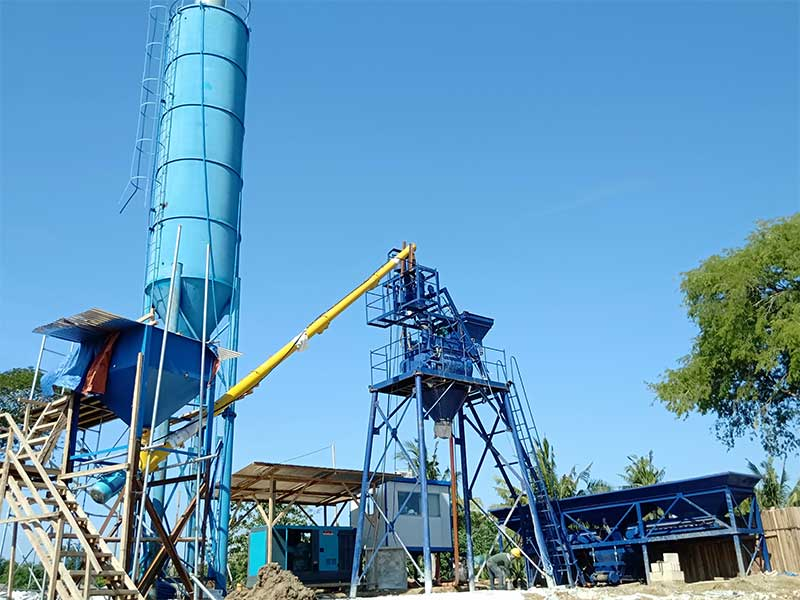
Accurate Material Batching Ensures Consistent Mix Designs
One of the biggest advantages of a stationary concrete batching plant is its precise batching system.
Concrete production requires accurate proportions of several raw materials, including:
Cement
Sand
Coarse aggregates
Water
Chemical admixtures
Mineral additives
Even small deviations can affect the final concrete performance.
Modern stationary batching plants use electronic weighing systems to measure each ingredient with high precision, reducing variations between batches.
This consistency helps achieve:
Uniform compressive strength
Stable workability
Consistent setting times
Improved durability
Automated Control Systems Minimize Human Error
Human error is one of the leading causes of inconsistent concrete quality.
Advanced stationary batching plants are equipped with automated control systems that manage the entire production process.
Automation controls:
Material feeding
Ingredient weighing
Mixing cycles
Water dosing
Admixture addition
Production monitoring
Benefits include:
Reduced operator dependency
Improved production accuracy
Faster adjustments
Real-time quality monitoring
Automation ensures every batch follows the same predefined recipe.
High-Efficiency Mixers Produce Uniform Concrete
The mixer is the heart of a stationary concrete batching plant.
Most modern systems use twin-shaft mixers because they provide excellent mixing performance.
Benefits include:
Better Material Distribution
All ingredients are evenly dispersed throughout the mixture.
Faster Mixing Cycles
Efficient mixers reduce production time while maintaining quality.
Improved Concrete Homogeneity
Uniform consistency prevents weak spots within the concrete.
Better Admixture Integration
Chemical additives are thoroughly blended for optimal performance.
The result is stronger and more reliable concrete.
Precise Water Control Improves Strength and Durability
Water content directly affects concrete performance.
Excessive water can cause:
Reduced strength
Increased shrinkage
Surface cracks
Poor durability
Insufficient water may lead to:
Poor workability
Incomplete hydration
Difficult placement
Stationary batching plants use automated water dosing systems to maintain the correct water-to-cement ratio.
Some advanced plants also include moisture sensors that automatically adjust water levels based on aggregate moisture content.
This ensures optimal concrete performance under changing environmental conditions.
Consistent Aggregate Management Enhances Quality
Aggregates account for approximately 60% to 75% of concrete volume.
Poor aggregate management can negatively impact concrete quality.
Stationary plants improve aggregate control through:
Separate Storage Bins
Different aggregate sizes are stored separately to avoid contamination.
Controlled Feeding Systems
Conveyors deliver precise amounts of aggregate to the mixer.
Moisture Monitoring
Sensors detect moisture variations and adjust batching accordingly.
Reduced Material Segregation
Proper handling maintains aggregate uniformity.
Consistent aggregate quality leads to more stable concrete performance.
Admixture Precision Optimizes Concrete Properties
Modern construction projects often require specialized concrete properties.
Chemical admixtures help achieve specific performance goals, such as:
Faster curing
Improved flowability
Reduced water demand
Enhanced freeze-thaw resistance
Increased durability
Stationary batching plants accurately dose admixtures according to project specifications.
Precise dosing ensures predictable results in every batch.
Continuous Production Maintains Batch Consistency
Large construction projects require a steady supply of concrete over extended periods.
Inconsistent production can create quality variations between batches.
Stationary plants support continuous production by offering:
Large material storage capacity
Automated feeding systems
High-output mixers
Stable production cycles
This ensures that all concrete delivered to the project maintains consistent quality.
Real-Time Monitoring Improves Quality Control
Advanced batching plants include intelligent monitoring systems.
Operators can track:
Material consumption
Production rates
Mix designs
Equipment status
Batch records
Error notifications
Data-driven monitoring allows immediate adjustments when deviations occur.
Benefits include:
Improved traceability
Faster troubleshooting
Reduced waste
Enhanced quality assurance
Digital records also simplify compliance with project documentation requirements.
Dust Collection Systems Protect Material Purity
Dust contamination can compromise concrete quality.
Modern stationary batching plants use dust collection systems to:
Capture cement dust
Reduce airborne particles
Protect material accuracy
Improve environmental compliance
Cleaner production environments help maintain consistent concrete formulations.
Stable Plant Structures Reduce Production Variations
Unlike mobile systems that are frequently relocated, stationary plants remain permanently installed.
Stable installation offers several advantages:
Reduced vibration
Better equipment alignment
Improved weighing accuracy
Lower wear and tear
More reliable production
Long-term stability contributes to consistent concrete output.
Better Quality Control Supports International Standards
Many projects must comply with international quality standards.
Stationary batching plants help manufacturers meet requirements such as:
ISO certifications
ASTM standards
EN standards
Local building regulations
Standardized production processes improve customer confidence and reduce project risks.
Applications That Benefit from High-Quality Concrete Production
Stationary concrete batching plants are widely used in projects that demand strict quality control.
Common applications include:
Commercial Buildings
High-rise buildings require consistent structural strength.
Infrastructure Projects
Roads, highways, tunnels, and bridges need durable concrete.
Industrial Facilities
Factories and warehouses require strong foundations.
Precast Concrete Manufacturing
Uniform concrete is essential for prefabricated components.
Airports and Ports
Heavy-load environments demand exceptional durability.
Tips for Maximizing Concrete Quality
To achieve the best results, operators should:
Regularly calibrate weighing systems
Inspect mixers frequently
Monitor aggregate moisture levels
Maintain dust collection equipment
Train operators properly
Follow preventive maintenance schedules
Use high-quality raw materials
Consistent maintenance directly impacts concrete quality.
Why Contractors Prefer Stationary Concrete Batching Plants
Construction companies increasingly choose stationary batching plants because they offer:
High production capacity
Superior batching accuracy
Consistent concrete quality
Lower operating costs
Long-term reliability
Intelligent automation
Strong return on investment
These advantages make them ideal for medium and large-scale projects.
Final Thoughts
A Stationary Concrete Batching Plant significantly improves concrete quality by combining precise batching, advanced automation, efficient mixing, and continuous quality control.
By minimizing human error and standardizing production processes, these plants deliver stronger, more durable, and more consistent concrete for modern construction projects.
For contractors, concrete suppliers, and infrastructure developers, investing in a high-quality stationary concrete batching plant is more than an equipment purchase—it is a long-term strategy for improving project performance, reducing risks, and ensuring construction excellence.