Knowledge Center
A SUPPLIER SPECIALIZING IN PROFESSIONAL CONSTRUCTION MACHINERY SOLUTIONS
What Is Concrete?
Nov. 12, 2026
Share :
What Is Concrete? The Ultimate Guide to Composition, Grades, Manufacturing, and Quality Control
Category: Industry Knowledge & Engineering Guide / Concrete Technology
Target Audience: Civil Contractors, Concrete Producers, Project Managers & Equipment Buyers
Reading Time: 8–10 Minutes
Quick Summary: Concrete is the world’s most consumed man-made building material. Formed by a chemical reaction between cement, water, and aggregates, modern concrete can be tailored for high compressive strength, durability, and rapid construction using advanced automated batching plants.
1. What Is Concrete? (The Direct Definition)
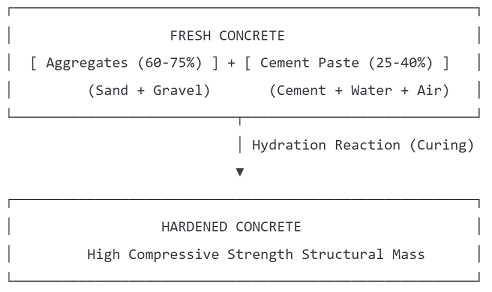
Concrete is a composite construction material composed of fine and coarse aggregates bonded together by a fluid cement paste that hardens over time through a chemical reaction called hydration.
When fresh, concrete is a pliable, moldable slurry that can be pumped, poured, and shaped into complex forms. Once cured, it transforms into an artificial stone-like structural material possessing high compressive strength, exceptional fire resistance, and long-term environmental durability.
2. The Core Components of Modern Concrete
Concrete is essentially a two-part matrix: Aggregates (the skeleton) and Paste (the binder). Achieving the optimal mix requires precise batching of four fundamental elements plus chemical/mineral admixtures:
|
Component |
Typical Volume |
Core Engineering Function |
Key Quality Standard |
|
Portland Cement |
10% – 15% |
The primary hydraulic binder; reacts chemically with water to form calcium silicate hydrate (C-S-H) gel. |
ASTM C150 / EN 197-1 (Type I–V) |
|
Water |
15% – 20% |
Activates cement hydration and provides workability (slump) for placing and finishing. |
Clean, potable, free from organic impurities / salts |
|
Coarse Aggregate |
40% – 45% |
Crushed granite, basalt, or gravel (5–40 mm) providing bulk compressive strength and dimensional stability. |
Tough, angular, well-graded, low water absorption |
|
Fine Aggregate (Sand) |
25% – 30% |
River sand or manufactured sand (0.15–5 mm) filling voids between coarse stones to create a dense matrix. |
Proper fineness modulus (2.3–3.1), clean & silt-free |
|
Entrained Air |
1% – 6% |
Microscopic air bubbles providing freeze-thaw resistance and enhancing fluidity. |
Uniform microscopic distribution |
|
Admixtures & Additives |
0.5% – 2% |
Water reducers, superplasticizers, retarders, accelerators, silica fume, and fly ash for specialized performance. |
ASTM C494 / EN 934 |
3. Concrete Strength Grades: From Non-Structural to Ultra-High Performance
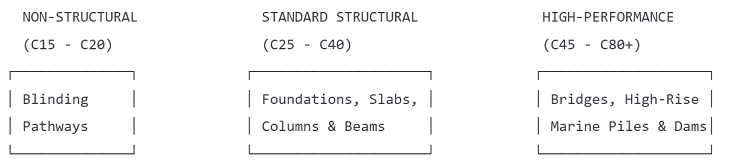
Concrete is globally classified by its characteristic compressive strength, measured in megapascals (MPa) or pounds per square inch (psi) after standard 28-day water curing.
|
Grade (EN/ISO) |
Equivalent (US / psi) |
Compressive Strength (28-Day) |
Typical Applications |
|
C15 / C20 |
~2,000 – 3,000 psi |
15 – 20 MPa |
Foundation blinding, leveling layers, pedestrian walkways, curbs. |
|
C25 / C30 |
~3,500 – 4,500 psi |
25 – 30 MPa |
Residential slabs, driveways, retaining walls, standard footings. |
|
C35 / C40 |
~5,000 – 6,000 psi |
35 – 40 MPa |
Commercial building columns, structural beams, heavy-duty industrial floors. |
|
C45 / C50 |
~6,500 – 7,500 psi |
45 – 50 MPa |
Precast concrete elements, highway bridge decks, water-retaining structures. |
|
C60 & Above (HPC) |
> 8,500 – 12,000+ psi |
60 – 100+ MPa |
High-rise skyscraper lower columns, marine piers, long-span viaducts. |
4. The Chemistry of Concrete: Hydration & Curing Stages
Concrete does not "dry" to gain strength; it cures chemically. If concrete dries out prematurely, the hydration reaction ceases, leading to cracking, low strength, and dusting surfaces.
Mixing & Plastic Stage (0–2 Hours): Water lubricates aggregate particles. Concrete remains fluid and workable, allowing transit, pumping, placing, and vibrating.
Initial Setting (2–4 Hours): Cement grains form crystalline needles that interlock, causing the paste to stiffen and lose plasticity.
Final Setting (4–8 Hours): Concrete solidifies and can no longer be molded; it begins sustaining its own self-weight.
Hardening & Strength Gain (1–28 Days & Beyond):
Day 3: Reaches approx. 40% – 50% of design strength.
Day 7: Reaches approx. 65% – 75% of design strength (safe for stripping certain formwork).
Day 28: Attains 100% nominal design strength (standard engineering benchmark).
Long Term (Months to Years): Strength continues to increase slowly in moist environments.
5. Concrete Production Methods: On-Site Mixing vs. Commercial Ready-Mix (RMC)
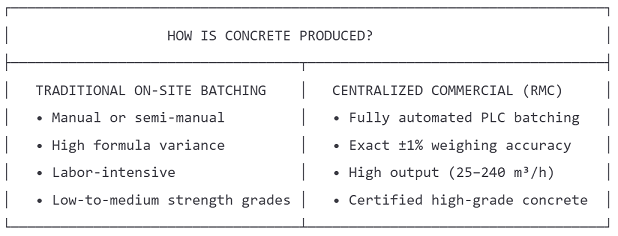
Why Commercial Ready-Mix Concrete (RMC) Dominates Modern Construction:
Precision Computerized Batching: Independent high-precision load cells ensure aggregates, cement, fly ash, water, and liquid admixtures are dosed within ±1% accuracy, eliminating human mixing errors.
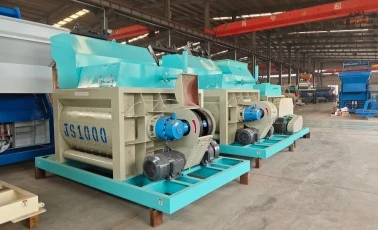
Intensive Forced Twin-Shaft Mixing: Industrial twin-shaft compulsory mixers (such as JS series or SICOMA mixers) generate strong three-dimensional turbulence, fully shearing cement agglomerates in 45–60 seconds.
High Volume Supply: Automated batching plants deliver steady outputs from 25 m3/h to 240 m3/h, keeping massive pours (foundations, bridge piers, tunnel liners) uninterrupted.
Environmentally Enclosed Operation: Modern plants incorporate pulse-jet dust collectors, aggregate covers, and water recycling systems, drastically cutting site pollution.
6. Crucial Factors Governing Concrete Quality & Durability
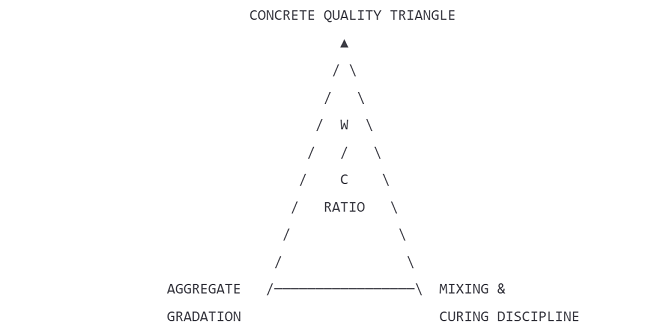
1). The Water-to-Cement (W/C) Ratio (Abrams' Law)
The single most critical rule in concrete engineering: Lower water-cement ratio yields higher compressive strength and lower permeability.
High W/CW/C ratio (>0.55): Excessive water evaporates, leaving microscopic capillary pores that weaken the matrix and allow water/chloride intrusion.
Low W/CW/C ratio (0.32–0.42): Produces ultra-dense, durable, high-strength concrete (requires superplasticizers for workability).
2). Aggregate Particle Size Distribution & Cleanliness
Poorly graded aggregates leave large voids requiring excess cement paste, increasing thermal cracking risks and cost. Aggregates must be clean, free from organic clay, silt, and reactive silica.
3). Mixing Homogeneity & Compaction
Incomplete mixing creates localized weak pockets. After placing, concrete must be thoroughly consolidated using internal vibrators to expel trapped air pockets without causing segregation.
4). Moist Curing Control
Maintaining surface moisture (via water spraying, wet burlap, or curing compounds) for at least 7 days prevents early shrinkage cracks and allows maximum hydration.
7. Frequently Asked Questions (FAQ)
Q1: What is the difference between Cement, Mortar, and Concrete?
Cement: The ultra-fine binding powder made from calcined limestone and clay (the "glue").
Mortar: A mixture of cement, water, and fine sand used as an adhesive for brickwork and plastering.
Concrete: A structural composite combining cement, water, sand, and coarse stone/gravel.
Q2: Why is Reinforced Concrete (RC) used instead of Plain Concrete?
Plain concrete is exceptionally strong in compression (pushing forces) but weak in tension (pulling/bending forces), with tensile strength only 10% of compressive strength. Steel rebar or prestressed steel tendons are embedded within concrete tension zones to absorb tensile loads, creating Reinforced Concrete (RC).
Q3: What is "Slump" and why does it matter?
Concrete slump measures the consistency and fluidity (workability) of freshly mixed concrete using a standard ASTM C143 slump cone test.
Low slump (25–75 mm): Stiff concrete for pavements, dams, and slip-form paving.
Medium slump (100–150 mm): General commercial columns, beams, and slabs.
High slump (160–220+ mm): Highly workable or self-consolidating concrete (SCC) for deep piling, pumping through long pipelines, and congested rebar cages.
Q4: How does temperature affect concrete pouring?
Hot Weather (>32∘C / 90∘F): Accelerated hydration causes rapid slump loss, flash setting, and thermal cracking. Mitigation: Chilled mixing water, night pouring, retarding admixtures.
Cold Weather (<5∘C / 40∘F): Hydration slows drastically; if fresh concrete freezes below −2∘C, internal water expands and destroys structural integrity. Mitigation: Heated batching water, aggregate heating systems, insulating blankets.
8. Power Your Concrete Production with Shengmao Machinery
Producing certified, high-margin concrete starts with reliable, precision-engineered machinery. Shengmao Machinery has spent decades developing high-performance concrete production and pumping equipment trusted by contractors across 30+ countries.
Our Core Concrete Equipment Lineup:
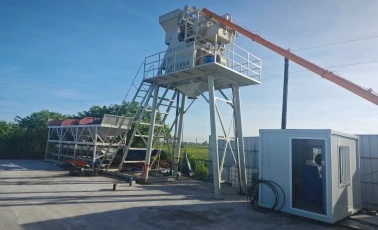
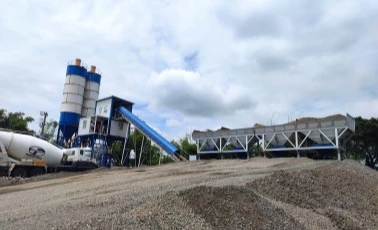
Stationary Concrete Batching Plants (HZS25 – HZS240): High-capacity commercial RMC hubs with belt or skip-hoist feeding and PLC automation.
Mobile Concrete Batching Plants (YHZS / YHZM / YHZG Series): Fast-towed all-in-one batching plants on integrated trailer chassis.
Foundation-Free Concrete Plants (FHZS Series): Modular steel-structure plants requiring zero civil concrete foundations.
Concrete Pumps & Boom Pumps: Trailer-mounted diesel/electric pumps and self-propelled crawler pumps (20–100 m3/h) with Euro V engine options.
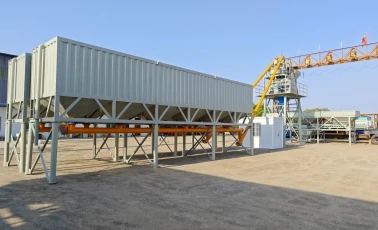
Silo & Storage Systems: Bolted cement silos (50–1000 T), horizontal low-profile silos, and big-bag ton-bag unloaders with built-in cranes.
Need Customized Concrete Solutions for Your Project?
Whether setting up a regional commercial ready-mix business or selecting heavy-duty equipment for bridge, highway, and building projects, our engineering team provides end-to-end support—from plant layout design to on-site commissioning.
Email: sales@shengmaomachinery.com
WhatsApp / WeChat: +86-18703719962
CONTACT US
Get A Free Quote Instantly Online!
RELEVANT KNOWLEDGE

Obtain Free Product Quotations
Feel free to reach out for any queries. We would be happy to help!
View More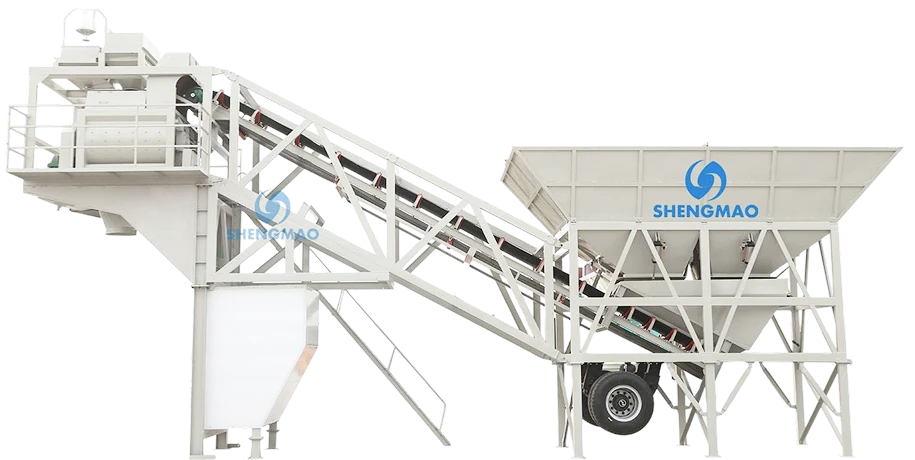


 Concrete Batching Plant