Knowledge Center
A SUPPLIER SPECIALIZING IN PROFESSIONAL CONSTRUCTION MACHINERY SOLUTIONS
What Is a Concrete Grade?
Nov. 12, 2026
Share :
Concrete Grades Explained: The Complete Engineering Guide to Strength Classes, Standards, and Mix Selection
Category: Industry Knowledge & Engineering Guide / Concrete Technology
Target Audience: Civil Contractors, Structural Engineers, Ready-Mix Concrete (RMC) Producers & Project Managers
Reading Time: 9–11 Minutes
Quick Summary: Concrete grade represents the standardized characteristic compressive strength of hardened concrete after 28 days of curing. Understanding international grade designations (EN/ISO "C" system, ASTM "PSI" system, and BS/IS cube standards) ensures precise mix design, structural safety, cost efficiency, and compliance with civil engineering codes.
1. What Is a Concrete Grade? (The Direct Definition)
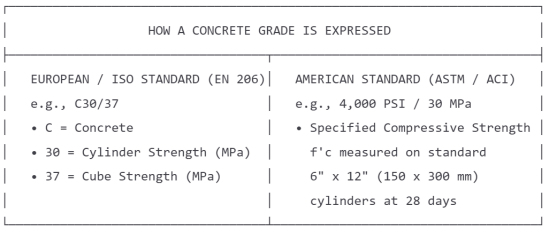
A Concrete Grade (or Concrete Strength Class) is a standardized classification indicating the minimum characteristic compressive strength that a batch of concrete must attain after 28 days of standard water curing, with a 95% statistical confidence level.
Concrete is specified by its compressive resistance because structural concrete is primarily designed to bear heavy vertical and compressive loads (in foundations, columns, beams, bridge piers, and slabs).
2. Global Concrete Classification Systems Compared
Different regions utilize distinct specimen geometries and measurement units to determine concrete strength. Understanding their correlation prevents costly on-site specification errors:
|
Standard / System |
Primary Region |
Specimen Geometry & Dimensions |
Notation Example |
Measurement Unit |
|
EN 206 / Eurocode |
Europe, Middle East, Africa, Global Export |
Cylinder (150×300 mm) & Cube (150 mm) |
C25/30, C30/37, C40/50 |
Megapascals (MPa / N/mm2) |
|
ASTM C39 / ACI 318 |
USA, Latin America, Philippines, Saudi Arabia |
Cylinder (150×300 mm / 6"×12") |
3,000 psi, 4,000 psi, 5,000 psi |
Pounds per Square Inch (psi) / MPa |
|
IS 456 / BS 1881 |
India, UK (Historical), Singapore, Commonwealth |
Cube (150×150×150 mm) |
M20, M25, M30, M40 |
Megapascals (MPa / N/mm2) |
|
GB 50010 |
China, Asian Infrastructure Projects |
Cube (150×150×150 mm) |
C20, C30, C40, C50, C60 |
Megapascals (MPa /N/mm2 |
Key Rule of Thumb: Cylinder compressive strength is typically 80%–85% of cube compressive strength for the same concrete mix because cylinder specimens experience less lateral restraint during compressive testing.
3. Comprehensive Concrete Grade Master Chart
The following reference table maps global concrete strength classes, typical water-cement (W/CW/C) ratios, characteristic strengths, and standard civil applications:
|
EN Grade (fck,cyl/fck,cube) |
Equivalent US (ASTM) |
Characteristic Strength (MPa) |
Nominal W/CW/C Ratio Guideline |
Concrete Category |
Primary Structural Applications |
|
C8/10 (M10) |
~1,500 psi |
10 MPa (Cube) |
0.65 – 0.70 |
Non-Structural / Lean |
Trench fills, sub-base blinding, leveling screeds |
|
C12/15 (M15) |
~2,000 psi |
15 MPa (Cube) |
0.60 – 0.65 |
Lean Concrete |
Pathway bedding, non-loadbearing mass fill, curb backing |
|
C16/20 (M20) |
~2,500 – 3,000 psi |
20 MPa (Cube) |
0.55 – 0.60 |
Plain / Light Structural |
Single-story residential footings, non-structural slabs |
|
C20/25 (M25) |
~3,500 psi |
25 MPa (Cube) |
0.50 – 0.55 |
Standard Structural |
Residential columns, beams, suspended slabs, retaining walls |
|
C25/30 (M30) |
~4,000 – 4,500 psi |
30 MPa (Cube) |
0.45 – 0.50 |
Standard Structural |
Commercial building slabs, highway pavements, water tanks |
|
C30/37 (M35) |
~5,000 psi |
37 MPa (Cube) |
0.40 – 0.45 |
Heavy Structural |
Heavy industrial flooring, parking structures, piling foundations |
|
C35/45 (M45) |
~6,000 psi |
45 MPa (Cube) |
0.38 – 0.42 |
High Performance (HPC) |
Precast beams, prestressed concrete elements, viaduct decks |
|
C40/50 (M50) |
~7,000 – 7,500 psi |
50 MPa (Cube) |
0.34 – 0.38 |
High Performance (HPC) |
Highway bridges, marine structures, tall building columns |
|
C50/60 (M60) |
~8,500 – 9,000 psi |
60 MPa (Cube) |
0.30 – 0.34 |
High Performance (HPC) |
Skyscraper foundation rafts, long-span bridge girders |
|
C60/75 – C80/95 |
10,000 – 14,000+ psi |
75 – 95 MPa (Cube) |
0.24 – 0.28 |
Ultra-High Performance |
High-rise mega-columns, nuclear containment, deep marine piles |
4. Deep Dive: Concrete Grades by Structural Category
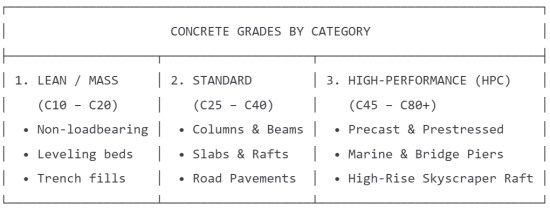
1). Low-Strength / Lean Concrete (C10, C15, C20)
Characteristics: Low cement content, high aggregate ratio, high water-cement ratio (0.55–0.70).
Primary Role: Serves as a clean leveling bed ("blinding layer") poured directly over excavated soil before placing steel reinforcement cages. Prevents structural concrete from mixing with mud or losing cement slurry into the ground.
Reinforcement: Unreinforced (plain concrete).
2). Standard Structural Concrete (C25, C30, C35, C40)
Characteristics: The workhorse of global building construction. Balanced cement dosage (320–420 kg/m3) with controlled water-cement ratios (0.40–0.50).
Primary Role: Engineered for reinforced concrete (RC) frames, foundations, suspended floor slabs, shear walls, retaining structures, and industrial driveways.
Reinforcement: Heavily reinforced with deformed steel rebar and welded wire mesh to resist bending and tensile stresses.
3). High-Performance Concrete / HPC (C45, C50, C60)
Characteristics: High binder content (incorporating microsilica, fly ash, or GGBS slag), low water-cement ratio (0.30–0.38), and advanced polycarboxylate ether (PCE) superplasticizers.
Primary Role: Infrastructure projects requiring high early strength, extreme wear resistance, and low permeability against chloride and sulfate corrosion (bridges, marine wharves, water-retaining dams, and precast prestressed girders).
4). Ultra-High Performance Concrete / UHPC (C70 to C100+)
Characteristics: Ultra-dense micro-aggregate grading, ultra-low W/CW/C ratio (<0.25), silica fume enrichment, and often reinforced with high-strength micro-steel fibers.
Primary Role: Mega-tall skyscraper lower columns (minimizing column cross-sections to maximize rentable floor area), seismic bridge joints, and military containment structures.
5. What Factors Determine Concrete Strength Grade?
Achieving a target concrete grade is not merely about adding more cement. A precise combination of raw materials, batching accuracy, and chemical technology dictates the final compressive outcome:
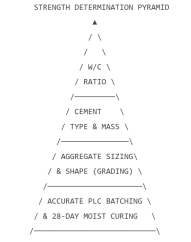
1). Water-to-Cement (W/CW/C) Ratio (Abrams' Law): The single most dominant factor. Lower water content increases C-S-H crystal density and reduces internal capillary porosity, elevating compressive strength.
2). Cement Grade & Quality: Using higher-strength cement classes (e.g., CEM I 42.5R or 52.5N / ASTM Type III) yields faster early strength and higher ultimate 28-day capacity.
3). Aggregate Gradation & Crushing Value: Well-graded angular crushed granite or basalt with low Flakiness Index and low Aggregate Crushing Value (ACV <20%) produces significantly stronger concrete than rounded, smooth gravel.
4). Chemical Admixtures: High-range water reducers (Superplasticizers) reduce required mixing water by up to 30% while maintaining excellent flowability and slump retention.
5). Computerized Batching Accuracy: Manual volume batching creates±10% formula variance. Automated industrial batching plants with precision load cells limit batching error to within ±1%, ensuring exact target grade achievement.
6. How Concrete Grades Are Tested and Verified
To confirm that commercial concrete meets design specifications, standard quality assurance (QA/QC) protocols are enforced on every major pour:

1). Slump Test on Arrival: Tests fresh workability and consistency before discharging into pumps or crane buckets (ASTM C143 / EN 12350-2).
2). Specimen Casting: Representative samples are cast in steel or polyurethane cube (150 mm150 mm) or cylinder (150×300 mm) moulds, compacted in layers using vibrating tables or tamping rods.
3). Standard Water Curing: Specimens are demoulded after 24 hours and fully submerged in a temperature-controlled curing tank at 20∘C±2∘C (68∘F).
4). 7-Day Early Strength Testing: Indicates early hydration progression (typically expected to reach65%–75% of nominal grade).
5). 28-Day Acceptance Test: The definitive legal benchmark crushed in a calibrated hydraulic compression testing machine to verify 100%100% design strength compliance.
7. Guarantee Exact Concrete Grades with Shengmao Machinery
Producing certified commercial concrete grades—from standard C25 foundation mixes to C60+ high-performance bridge mixes—demands precise material weighing, intensive forced mixing, and intelligent automated control.
Shengmao Machinery manufactures world-class concrete batching plants and pumping systems engineered for maximum formula accuracy and zero downtime:
Why Commercial Ready-Mix Producers Choose Shengmao Plants:
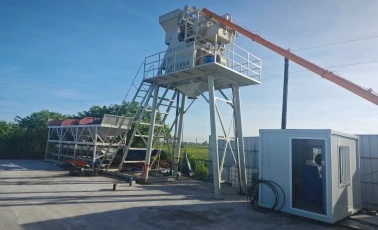
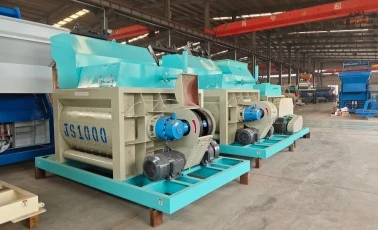
JS & SICOMA Twin-Shaft Compulsory Mixers: Forced counter-current 3D mixing guarantees complete cement dispersion and homogeneous grade consistency within 45–60 seconds.
High-Precision Independent Load Cells: Aggregate, cement, fly ash, water, and additive scales deliver certified batching accuracy within ±1%.
Dual-Screen Smart Industrial PLC Control: Automatic moisture compensation, hundreds of formula presets, real-time batch recording, and error alarms.
Complete Product Range:
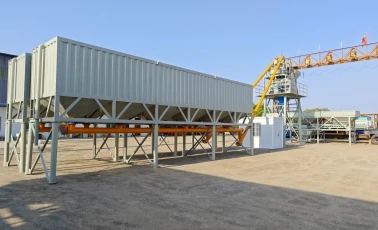
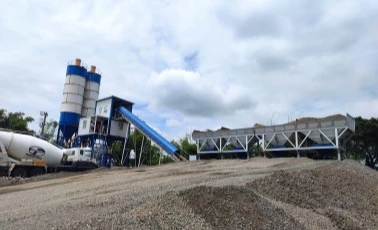
Stationary Ready-Mix Plants (HZS25 – HZS240): 25 m3/h25 m3/h to 240 m3/h240 m3/h commercial hubs.
Mobile Concrete Batching Plants (YHZS / YHZM / YHZG): Fast-relocating trailer-mounted plants.
Foundation-Free Concrete Plants (FHZS Series): Zero civil foundation costs for rapid project deployment.
Concrete Pumps & Booms: Crawler and trailer-mounted diesel concrete pumps (20–100 m3/h20–100 m3/h) with Euro V engine options.
A: No. Structural engineering codes (such as ACI 318 and Eurocode 2) mandate a minimum of C25/30 (M25) or C30/37 (M30) for reinforced concrete columns and loadbearing suspended beams. C20 is restricted to single-story footings, non-structural floor leveling, and unreinforced mass pours.
A: Nominal Mix (e.g., 1:2:4 or 1:1.5:3): Fixed volume ratios historically used on small sites for low grades (C15–C20). It does not account for sand moisture or aggregate density variations. Design Mix: An engineered, laboratory-tested mix proportion calculated based on exact aggregate grading, moisture compensation, cement chemistry, and admixtures by weight. Mandatory for all grades C25 and above.
A: While concrete continues to hydrate and gain strength for years in moist environments, cement hydration achieves over 95%–99% of its nominal design strength within 28 days. It provides an internationally harmonized, legally binding milestone for structural engineers and contractors.
A: Hot weather (>30∘C): Accelerates early 1–3 day strength gain but can reduce ultimate 28-day strength by up to 10%–15% due to non-uniform crystal formation. Cold weather (<5∘C): Dramatically retards strength development; hydration halts completely if the mix freezes, causing permanent structural failure.
A: Infrastructure and coastal marine structures typically require C40/50 (M50 / 7,000 psi) or higher. Marine environments demand: 1). Low permeability to prevent seawater chloride ions from penetrating concrete and corroding internal rebar. 2). Maximum water-cement (W/C) ratio of ≤0.40. 3). Inclusion of mineral admixtures (Silica Fume, Fly Ash, or GGBS Slag) and sulfate-resistant Portland cement (ASTM Type V / CEM III).
CONTACT US
Get A Free Quote Instantly Online!
RELEVANT KNOWLEDGE

Obtain Free Product Quotations
Feel free to reach out for any queries. We would be happy to help!
View More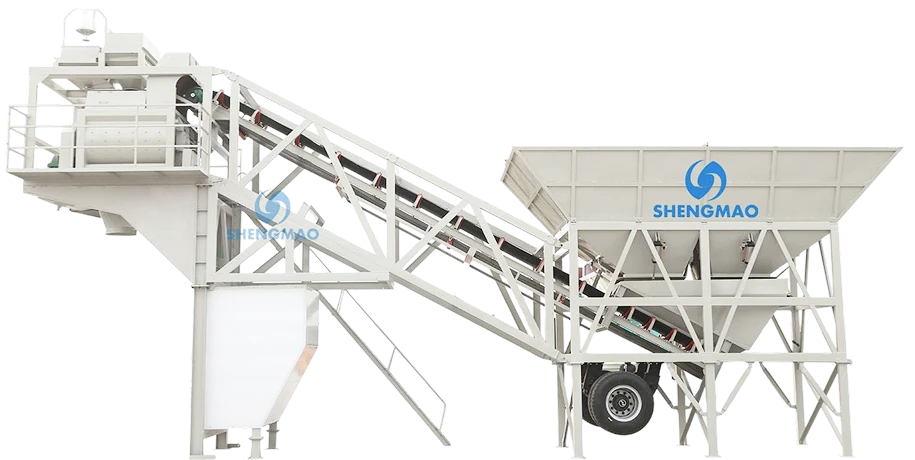


 Concrete Batching Plant